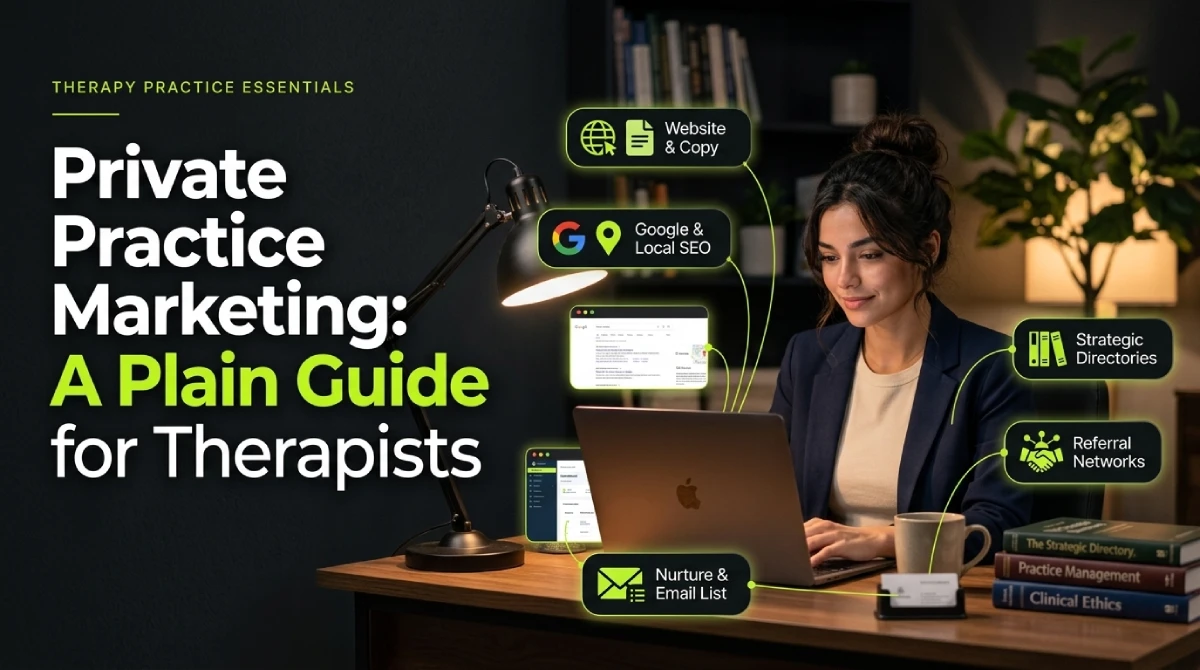
Private practice marketing is how the right clients find out you exist and decide to call you. For most therapists it rests on five things. A website that speaks to the people you help best. Being findable on Google when they search. Two or three well-chosen directories. Steady relationships with people who refer. And a gentle way to stay in touch with people who aren’t ready yet. Social media is optional. Paid ads are optional. The five things above are where most full practices get their clients.
This guide walks through each one in the order we’d do them, and links to a deeper guide for every step.
If the word “marketing” makes you wince
You’re in good company. Most therapists didn’t train for years so they could write sales copy. A lot of the marketing advice out there feels loud and pushy, and it clashes with how you work with people.
Try thinking about it differently. Somewhere near you, someone has been struggling for months. They’re looking for help right now, tonight, on their phone. They’d be a great fit for you. Marketing is just making sure they can find you, and that when they do, they can tell you’re the right person.
Done well, it’s quiet, honest and useful. That’s the only kind this guide covers.
Step 1: Know who you’re for
Before anything else, get clear on who you most want to work with.
This helps you get found and remembered. You can still see anyone you like. I work with adults is hard to search for and hard to refer to. I work with new parents dealing with anxiety is easy for a GP to remember, easy for a friend to pass on, and easy for Google to match to a search.
Write down:
- The two or three issues you do your best work with
- The kind of person who usually comes to you with them
- What they say on the first call, in their own words
- Where you see people: in person, online, or both, and in which areas
Everything else in this guide gets easier once these are clear.
Step 2: Build a website that does its job
Your website is the one place where someone gets to know you without a competitor sitting beside your photo. Almost every route a client takes to find you ends with them looking at it. A friend mentions you, they Google your name. A doctor gives them a list, they look at each website. They see your directory profile, they click through to check you out.
So the website has two jobs. Help new people find you through search. And help everyone who already heard about you decide to get in touch.
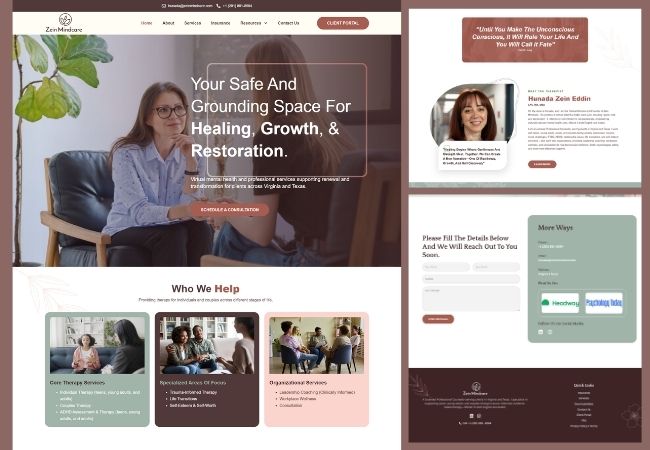
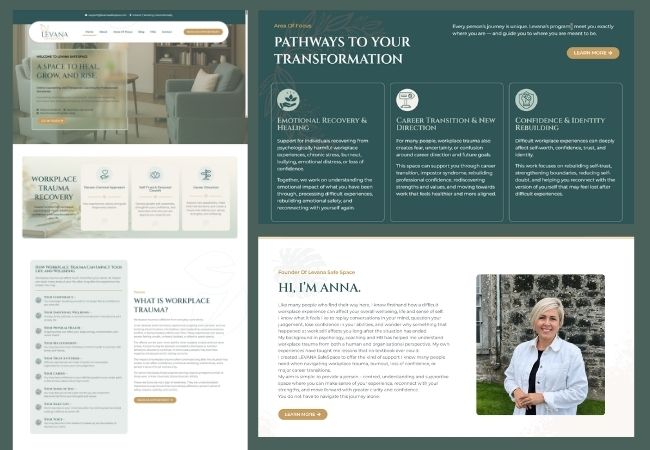
The second job is mostly about words. A homepage that talks to the reader’s experience instead of listing your services. A page for each specialty. Fees stated plainly. A booking button that’s easy to find on a phone. A bio that makes someone feel understood.
Go deeper:
- Therapist website copywriting: what to write on every page
- How to write a therapist bio
- Therapy clients from a website: the real numbers
Step 3: Get found on Google
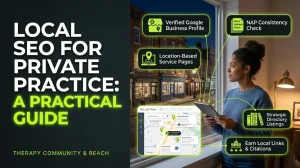
When someone in your town searches therapist near me or couples counselling plus their city, Google shows a map with three practices, then a list of websites. Being in either place brings in a steady flow of enquiries that doesn’t depend on you posting anything.
Three pieces work together:
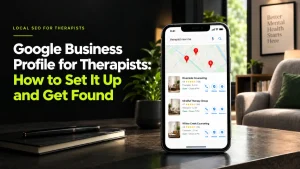
Your Google Business Profile. Free, quick to set up, and usually the fastest win. It’s what puts you on the map.
Your website’s pages. One page per specialty, with your location mentioned naturally, so Google can match you to specific searches.
Local signals. Your practice name, address and phone number written the same way everywhere, plus links from local organisations.
Local search usually starts moving in three to four months. It’s slow at the start and steady after.
Go deeper:
- Google Business Profile for therapists
- SEO for therapists: a plain-English guide
- Local SEO for private practice
Step 4: Be easy for AI tools to describe
More people now ask ChatGPT, Gemini or Google’s AI answers to suggest a therapist. Those tools pull from what’s written about you across the web. Nobody controls exactly what they say, but clear, specific, consistent information helps a lot. Say plainly who you help, where and how. Answer common questions directly. Keep your details the same everywhere.
Go deeper: AI search for therapists: how to show up in ChatGPT
Step 5: Choose two or three directories
Directories still bring in enquiries, especially while your own website is building up. The mistake is joining ten of them, or relying on one for everything.
Pick the largest one in your country, the one tied to your professional body, and maybe one that fits your niche. Track which ones actually send clients. Drop the ones that don’t after six months.
Go deeper:
- The best therapist directories, ranked honestly
- Psychology Today vs your own website
- How to get therapy clients without Psychology Today
Step 6: Build referral relationships
Referrals are often a practice’s best clients. They arrive already trusting you because someone they trust sent them.
The trick is to treat referrals as relationships you look after.
Make a list of ten people who regularly meet your ideal clients. Depending on your work that might be:
- GPs and family doctors
- Psychiatrists and psychiatric nurse practitioners
- Other therapists who don’t offer what you offer, or who are full
- School counsellors and university wellbeing teams
- Obstetricians, midwives and health visitors, if you work with new parents
- Family lawyers and mediators, if you work with separating couples
- Employee assistance programmes and HR teams
Get in touch personally. Tell them in one sentence who you help best. Offer to be someone they can call. Thank them when they send someone (without sharing anything about the client). Check in a couple of times a year.
Then make sure your website confirms what you told them, because they’ll check, and so will the people they send.
Step 7: Stay in touch with people who aren’t ready
Deciding to start therapy can take months. Someone might find your website in March and not contact you until September.
Two quiet ways to stay in their mind:
A few helpful articles. Answer the questions people ask before they’re ready. How do I know if I need therapy? Is it normal to still be grieving after a year? One thoughtful article a month is plenty.
A simple email list. A short note once a month. A reflection, a resource, an update. Offer something small and useful on your site in exchange for an email, like a grounding exercise or a short guide.
Keep both kind, useful and regular.
Step 8: Decide about social media
You don’t need it. Plenty of full practices have no Instagram at all.
It can help if you enjoy it, if your niche gathers in a particular place online, or if you do corporate or training work where LinkedIn matters. If it drains you, it’s fine to skip it and put that time into the steps above.
Go deeper: Therapist marketing without social media
Step 9: Look after privacy and ethics
Therapy marketing comes with rules most businesses don’t have.
- Reviews and testimonials. Many professional codes, including the APA’s in the US, discourage asking current clients for testimonials. Never confirm someone was a client when replying to a review.
- Your website’s forms and tools. Contact forms, email, booking and tracking tools can all expose client information if they’re set up carelessly.
- Claims. Don’t promise outcomes, and only call yourself a specialist if your professional body allows it.
Go deeper: HIPAA compliant therapy website: what actually matters (with a section for UK practices)
Step 10: Measure what’s working
One habit does most of the work. Ask every new enquiry how they found you, and write it down.
Add your Google Search Console clicks and Google Business Profile insights once a month. After six months you’ll know exactly where your best clients come from, and you can put more time there and less everywhere else.
Go deeper:

A 90-day private practice marketing plan
If all of this feels like a lot alongside a full caseload, here’s a gentle order to do it in.
Month 1: foundations
- Write down who you help best, in their words
- Set up or clean up your Google Business Profile
- Fix the top of your homepage: a headline for the reader, one line on who you help and where, a visible booking button
- Start asking every enquiry how they found you
Month 2: get found
- Write a page for your main specialty
- Make sure your name, address and phone match across your website and directories
- Connect Google Search Console
- Contact five people on your referral list
Month 3: keep it going
- Write a page for your second specialty
- Review your directories and drop any that aren’t sending anyone
- Write one helpful article
- Contact the other five on your referral list
- Look at your tracking sheet and decide where to spend next quarter
After that, one new page or article a month and a quick look at your numbers is enough to keep things moving.
What to skip in private practice marketing
- Posting on social media every day because someone said you should
- Paying for ten directories
- Buying links, reviews or “guaranteed rankings”
- Long contracts with anyone who won’t tell you exactly what they’re doing each month
- Redesigning your logo before you’ve fixed your homepage words
Doing it yourself, or getting help
Every step in this guide can be done by one therapist with a few hours a month. If you enjoy learning it, start with month 1 above.
If you’d rather spend those hours with clients, this is the work we do every week for therapists in the US, UK, Ireland and Australia. See our therapist website design work, our SEO services for therapists, or book a free 30-minute call and I’ll tell you honestly which steps would make the biggest difference for your practice right now.
Frequently asked questions
What is the best marketing for a therapy private practice? For most therapists, a website written for their ideal client, a complete Google Business Profile and steady referral relationships bring the most reliable clients. Add two or three directories while your website builds up. Social media and paid ads are optional extras for most practices.
How do I market my private practice with no budget? Start with free steps. Set up your Google Business Profile, rewrite the top of your homepage for your ideal client, list yourself in a free directory like TherapyDen, and contact ten people who could refer to you. Track where every enquiry comes from so you know what’s working.
How long does it take to build a private practice caseload? It varies with your area, specialty and starting point. Referral relationships can bring clients within weeks. Local search usually starts moving in three to four months, and most practices see enquiries from it within six. Consistent small steps beat occasional big pushes.
Do therapists need social media to get clients? No. Many full practices have no social media presence at all. Search, referrals, directories and a good website bring in most clients. Social media can help if you enjoy it or if your niche gathers there, but it’s optional.
Should I hire someone to do my practice marketing? It depends on your time and interest. You can do the basics yourself with a few hours a month. If you’d rather focus on clients, look for someone who knows therapy, tells you exactly what they do each month, and doesn’t promise guaranteed rankings.