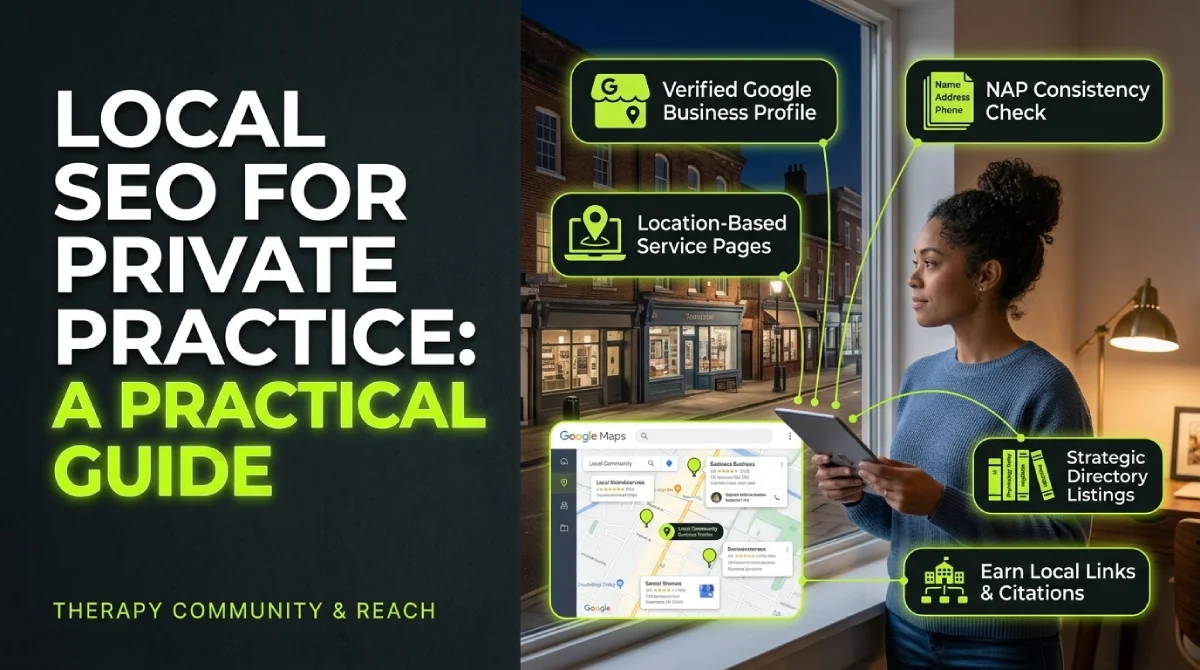
Local SEO for private practice is the work that helps you show up when people nearby search for help, like therapist near me or counselling in Bristol. Google decides who to show for these searches based on three things: how well you match the search, how close you are, and how established and trusted your practice looks locally. You can’t change where your office is. You can make sure Google knows exactly where it is, what you do there, and that other local sources agree. This guide covers the local signals in detail.
If you’re new to SEO, start with our SEO for therapists guide, which covers the basics. This post picks up from there.
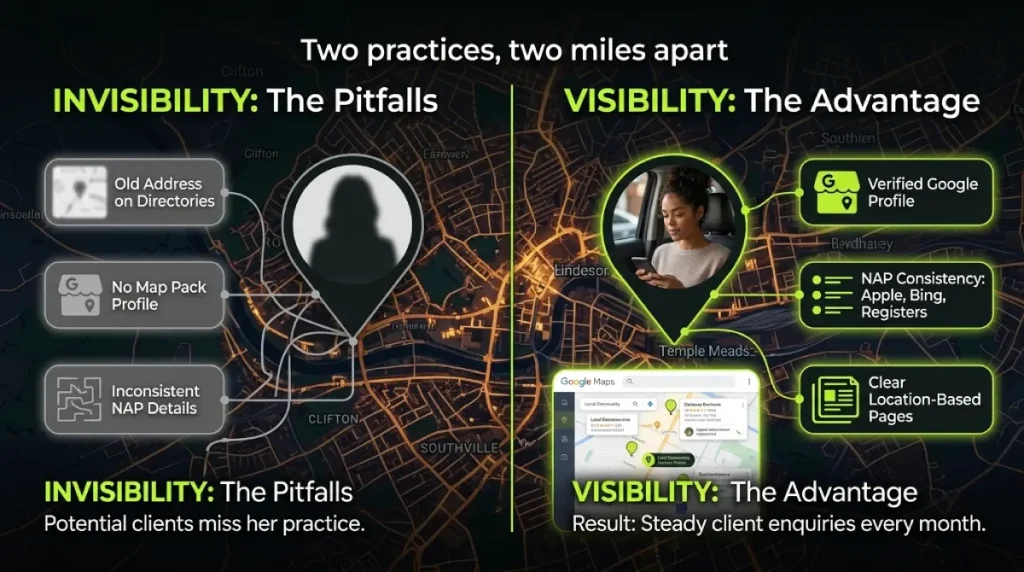
Two practices, two miles apart
Imagine two therapists on opposite sides of the same city. Same specialty. Both have decent websites.
Someone searches trauma therapist near me from a street halfway between them. One appears in the map results. The other doesn’t, even though she’s just as close.
When you dig in, the difference is a list of small things. The first therapist’s address is written the same way on her website, her Google profile and five directories. Two local organisations link to her site. Her contact page mentions the neighbourhood, the nearest station and where to park. The second therapist moved offices a year ago and her old address is still on three directories and her Google profile.
Google saw conflicting information about the second practice, so it trusted it a little less. That’s what local SEO is mostly about. Clear, consistent, local information, repeated in enough trusted places that Google feels sure about you.
How local SEO for private practice works
When someone searches with local intent, Google usually shows two kinds of results.
The map pack. A map with three businesses underneath. This comes mostly from Google Business Profiles.
The local website results. The normal list of websites below the map, chosen with location in mind.
You want to be in both. The map pack is driven mainly by your Google Business Profile and local signals. The website results are driven mainly by your site’s pages. Local SEO strengthens both at once.
1. Get your Google Business Profile right first
This is the single biggest local signal you control. The right primary category, a complete description, real photos, accurate hours, your services listed, and the correct address or service area.
We’ve written a full guide, including the confidentiality rules for replying to reviews: Google Business Profile for therapists.
2. Make your name, address and phone number match everywhere
SEO people call this NAP consistency: Name, Address, Phone. Every place your practice is listed online is a citation. Google compares them. When they match, Google trusts the information. When they don’t, it hesitates.
Do a citation check:
- Write down your practice name, address and phone number exactly as you want them to appear.
- Search Google for your practice name, your old address if you’ve moved, and your phone number.
- Make a list of every site that mentions you.
- Update each one to match. Close duplicates where you can.
Common places to check in the US: Google Business Profile, Apple Business Connect (for Apple Maps), Bing Places, Psychology Today, GoodTherapy, TherapyDen, your insurers’ provider directories, Healthgrades (for some licensed professions), Yelp, and your state licensing board’s lookup.
Common places to check in the UK: Google Business Profile, Apple Business Connect, Bing Places, Counselling Directory, the BACP, UKCP or NCPS registers, the HCPC register if you’re a psychologist, Psychology Today UK, Yell, and Hub of Hope.
Small differences like Street and St are fine. Different phone numbers, old addresses or two versions of your practice name are what cause problems.
Two often missed: Apple Maps and Bing. iPhone users searching through Siri or Apple Maps see Apple’s data. Several AI tools lean on Bing’s results. Claiming both takes twenty minutes.
3. Give your location a page worth reading
If you see clients in person, your website should make the location crystal clear. Usually that’s your contact page. If you have more than one office, each gets its own page.
A good location page includes:
- Your full address and a map embed
- Which neighbourhoods and nearby towns clients usually come from
- How to get there by public transport, and where to park
- What the building and entrance look like, and which floor you’re on
- Accessibility information: step-free access, lifts, toilets
- Which days and times you’re there
- A photo of the entrance or waiting area
This helps Google and it helps people. Someone nervous about a first session wants to know exactly where to go. Two minutes from Clapham North station, blue door next to the bakery, ring the top bell removes a real worry.
What to avoid: copy-paste location pages
If you work in one place, don’t create twenty pages for twenty nearby towns with the same text and a different place name swapped in. Google calls these doorway pages, and they can hurt the whole site.
What’s fine:
- A page for each office you actually work from
- If you work online across a region, one page explaining that, mentioning the main areas you serve
- Naturally mentioning nearby areas on your main pages, where it’s true
4. Mention your location naturally on service pages
Each specialty page should mention where you work, once or twice, in a natural way. Ideally in the page title and main heading too.
- Page title: Anxiety Therapy in Bristol | Jane Smith Counselling
- Heading: Anxiety Therapy in Bristol
- Opening: I’m a counsellor in Clifton, Bristol, helping adults with anxiety…
That’s enough. Don’t repeat the city in every paragraph. If you work online too, say so, and name the wider area: in person in Bristol and online across the UK.
Our therapist website copywriting guide has a full structure for these pages.
5. Earn local links
A link from a local website tells Google you’re part of that community. A handful of genuine local links often does more than dozens of random ones.
Places therapists often get local links from:
- Local charities and community organisations you volunteer with or support
- Schools, colleges and university wellbeing services that keep a list of local therapists
- GP surgeries or health centres with a resources page
- Local news sites, magazines or newsletters, if you contribute an article or comment
- Local podcasts and radio
- Your local business association or chamber of commerce
- Coworking spaces or wellness centres where you rent a room
- Colleagues’ websites, if you refer to each other
Ask politely, offer something useful (an article, a talk, a resource list), and never pay for links.
6. Reviews, handled carefully
Reviews are a local ranking signal, and they matter to people deciding between practices. For therapists they come with real ethical limits. Many professional codes discourage asking current clients for reviews, and you must never confirm someone was a client when replying.
Our Google Business Profile guide covers safe replies word for word. The short version: a profile with few reviews can still rank well if the rest of your local signals are strong.
7. Add local business schema
Schema is a bit of code on your website that tells search engines your practice’s details in a structured way: name, address, phone, hours, what you do. It doesn’t change how your site looks.
If your site runs on WordPress, SEO plugins like Rank Math or Yoast can add it without coding. Use the LocalBusiness type, or a more specific one that fits, and make sure the details match your Google profile exactly.
8. If you work from home or fully online
Home office where clients visit: you can hide your street address on Google and show a service area instead. Your website can say central Leeds or near Headingley without your exact address, and give the full address after booking.
Fully online: you may not be eligible for a Google Business Profile, because Google’s rules require in-person contact. Your local SEO then leans more on your website pages, directories and local links. Name the region you’re licensed or registered to work in, clearly, on your site.
How to tell if it’s working
Google Business Profile insights show how many people found your profile, called, asked for directions or visited your site.
Google Search Console shows which searches you appear for. Look for searches that include your town or near me.
Ask every new enquiry how they found you. If more people start saying Google Maps or I searched for a therapist in [your town], your local SEO is working.
Local search usually starts moving in three to four months. Quieter towns can move faster. Big cities can take longer.
Local SEO for private practice: a checklist
- Google Business Profile complete, with the right primary category
- Name, address and phone written the same on your site and every directory
- Old addresses and duplicate listings fixed
- Apple Business Connect and Bing Places claimed
- Contact or location page with directions, parking and accessibility
- Location mentioned naturally on each service page
- No copy-paste town pages
- Three to five genuine local links
- LocalBusiness schema matching your Google profile
- Monthly check of Search Console and profile insights
If you’d rather someone handled this, citation clean-up, local pages and Google Business Profile management are all part of our SEO services for therapists. For the bigger picture of where local SEO fits, see our private practice marketing guide. Or book a free 30-minute call and I’ll check your local listings with you.
Frequently asked questions
What is local SEO for a private practice? Local SEO is the work that helps your practice appear when people nearby search for services like yours, such as “therapist near me”. It covers your Google Business Profile, consistent name, address and phone details across the web, location information on your website, local links and reviews.
How do I show up in “therapist near me” searches? Complete your Google Business Profile with the right category, make sure your name, address and phone match everywhere you’re listed, mention your location naturally on your website, and earn a few local links. Google also weighs how close you are to the searcher, which you can’t change.
What are local citations for therapists? Citations are mentions of your practice’s name, address and phone number on other websites, such as directories, maps and professional registers. Google compares them with your website and Google profile. When they all match, it trusts your details more and you’re more likely to rank locally.
Should I make separate pages for each town I serve? Only for places you actually have an office. Creating many near-identical pages for nearby towns can be treated as spam by Google. If you work online across a region, one page explaining the areas you serve is better.
How long does local SEO take for a therapist? Local search usually starts moving in three to four months. Quieter towns can move faster, while competitive cities take longer. Fixing your Google Business Profile and citations often brings the earliest improvements, because they’re the signals Google uses most for map results.